Benelux Technology M&A: Q2 2026 market update | Flat on the surface, rotating underneath



Dealmaking activity in the Benelux technology sector held steady in Q2 2026, with CFI recording 141 transactions in collaboration with Computable, marginally ahead of the 140 deals in Q1 2026 and below the 154 recorded in Q2 2025. The headline stability conceals one of the most pronounced compositional shifts the region has seen in recent years. Add-on acquisitions rose to nearly half of all activity while sponsor-to-sponsor exits all but disappeared, Belgian activity surged to a multi-year high as Dutch volumes softened, and Benelux acquirers stepped up their pursuit of foreign targets. The quarter also delivered the macro event flagged as the principal risk in our Q1 commentary: on 11 June the European Central Bank raised its deposit rate by 25 basis points to 2.25%, its first increase since 2023.
Our Q1 update described a market caught between momentum and caution, with private equity awaiting clarity on the rate path. That clarity arrived, and it was not the answer sponsors wanted. The reversal of the easing assumption that underpinned much of the 2026 pipeline left its fingerprints across the quarter’s data.
“The second quarter answered the question everyone was asking in March, and the answer repriced the cost of capital,” says Randy de Visser, Director in CFI’s Benelux Technology team. “What is striking is that volume did not fall away. Buyers kept transacting at almost exactly the pace of the previous quarter. What changed is who was buying, what they were buying, and above all which exit routes were still open. This was not a slower market. It was a market that rotated.”
Sponsors consolidate, but stop exiting
The 141 transactions recorded in Q2 2026 represent a marginal increase on the previous quarter and a year-on-year decline of approximately 8%. For the first half as a whole, the region recorded 281 transactions against 315 in H1 2025, a decline of roughly 11%, but still comfortably ahead of the 227 deals recorded in H1 2019 and consistent with the structurally higher baseline the Benelux technology market has established since 2021.
Within that stable total, the deal mix moved sharply. Add-on acquisitions accounted for 68 transactions, or 48% of total volume, up from 60 in Q1 2026 and 63 in Q2 2025. This is the highest share in three quarters and sits comfortably above the two-year quarterly average of approximately 45%, though below the 56% peak recorded in Q3 2025. Sponsors continued to deploy capital, but overwhelmingly into platforms they already own.
At the other end of the spectrum, secondary buy-outs effectively stopped. Just one sponsor-to-sponsor transaction completed in Q2, against six in both Q1 2026 and Q2 2025, and the lowest quarterly figure since Q2 2024. Across the preceding six quarters the regional average had been approximately five per quarter. The route that had absorbed a meaningful share of regional exit pressure since 2024 closed almost entirely within a single quarter.
Capital raises tell a complementary story, falling to 14 transactions from 17 in Q1 and 24 in Q2 2025, a year-on-year decline of 42%. Outright acquisitions were broadly stable at 43 against 44 in Q1, while buy-outs rose modestly to 15 from 13.
Taken together, the pattern is unusually coherent. Sponsors bought more aggressively into existing platforms, formed materially fewer new ones, and sold to each other almost not at all. Capital circulated within the portfolio rather than moving through it.
The mechanism behind the exit freeze is straightforward. A secondary buy-out requires two sponsors to agree on price, each financing the transaction against a cost of debt that moved against them mid-quarter. When the buyer’s entry multiple and the seller’s exit expectation are both anchored to a rate environment that has just reversed direction, the transaction does not get repriced. It gets postponed. An add-on, by contrast, can be funded at the platform level, justified on synergies rather than on a standalone entry multiple, and completed without testing the market’s view of the asset’s value.
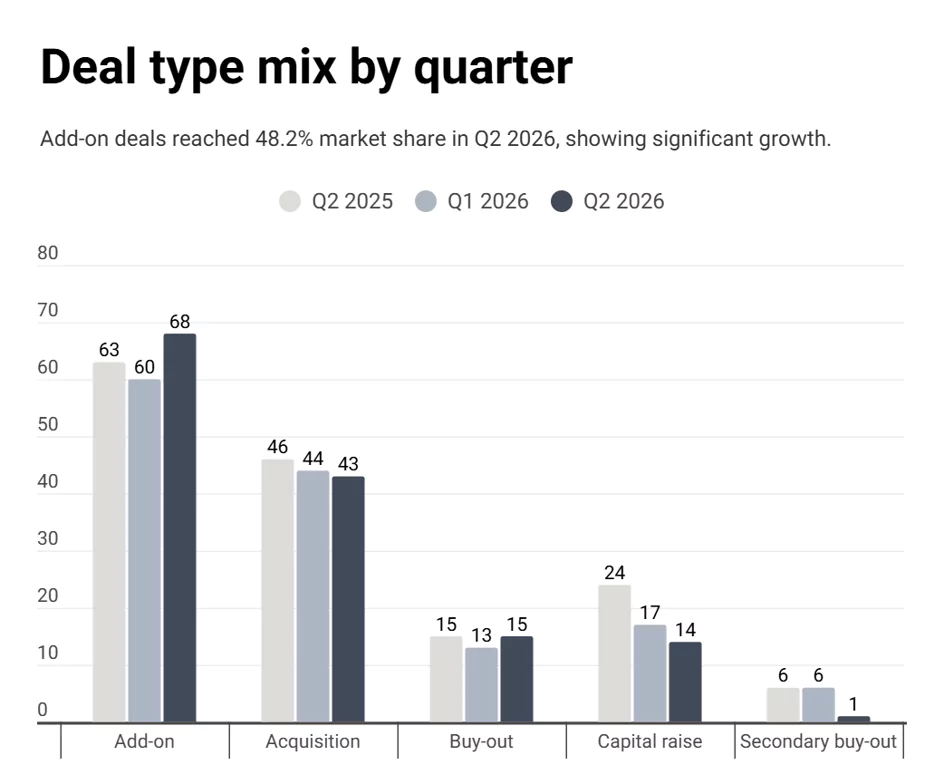
The vertical axis shows the number of transactions.
Landmark deals: quality still clears
Despite the constrained exit environment, Q2 produced several transactions that demonstrate where competitive tension remains concentrated.
The most instructive was Sixth Street’s acquisition of Kpler, the Brussels-headquartered commodity and maritime data platform. It was, notably, the single secondary buy-out completed in the region during the quarter. That the only sponsor-to-sponsor exit to clear involved a proprietary-data business of genuine international scale, sold to a large US investor, is the clearest available illustration of how narrow the exit window has become and what it takes to pass through it.
Apheon’s investment in Easi is the quarter’s clearest expression of the Belgian theme. Easi, headquartered in Nivelles and Leuven, supplies proprietary business software and managed IT services to more than 1,500 mid-market and large organisations across Belgium and Luxembourg. The transaction marks the first introduction of institutional capital into the company’s shareholder base, with founder Salvatore Curaba, the co-CEOs and a broad base of employee shareholders retaining significant ownership under a governance framework that preserves the employee ownership model. That an asset of this calibre selected a Brussels-based pan-European sponsor rather than a foreign one is the Belgian consolidation thesis in miniature.
Fortino Capital acquired Shiftbase, the Dutch workforce scheduling software business, continuing a pattern of Belgian sponsors deploying into Dutch software assets that recurs throughout the dataset. And Dynamate’s combination with Van Roey ICT Group brought together two Belgian IT services businesses in one of the quarter’s more substantial domestic consolidation moves.
All four transactions involve Belgian assets or Belgian sponsors, which is not a coincidence.
Belgium takes share as Dutch volumes soften
The clearest geographic development of the quarter was a marked shift in the balance of activity between the two core Benelux markets. Belgian targets accounted for 33 transactions, up from 25 in Q1 2026 and 21 in Q2 2025, an increase of 57% year-on-year and the highest figure in the recent series. Belgian acquirers were more active still, responsible for 36 transactions against 22 in the previous quarter, an increase of 64%. Domestic Belgian transactions rose to 19 from 12.
Dutch activity moved in the opposite direction. Dutch targets accounted for 73 transactions, down from 87 in Q1 and 86 in Q2 2025, while Dutch acquirers fell to 67 from 73. Domestic Dutch transactions declined to 44 from 54.
The Netherlands remains, by a considerable margin, the larger of the two markets. But the direction of travel has now been consistent for three consecutive quarters on both sides of the transaction, with Belgian targets rising from 17 in Q3 2025 to 22, then 25, then 33, and Belgian buyers following a similar path. That persistence is what distinguishes this from ordinary quarterly noise, and it is corroborated by a clear uptick in CFI’s own Belgian mandate flow over the same period.
The relative softness of the Dutch market is harder to explain than the Belgian strength. It is not obviously attributable to a single large process slipping between quarters, and Dutch fundamentals show no corresponding deterioration. Whether it reflects a temporary pause in seller supply or something more durable is a question the second half will answer.
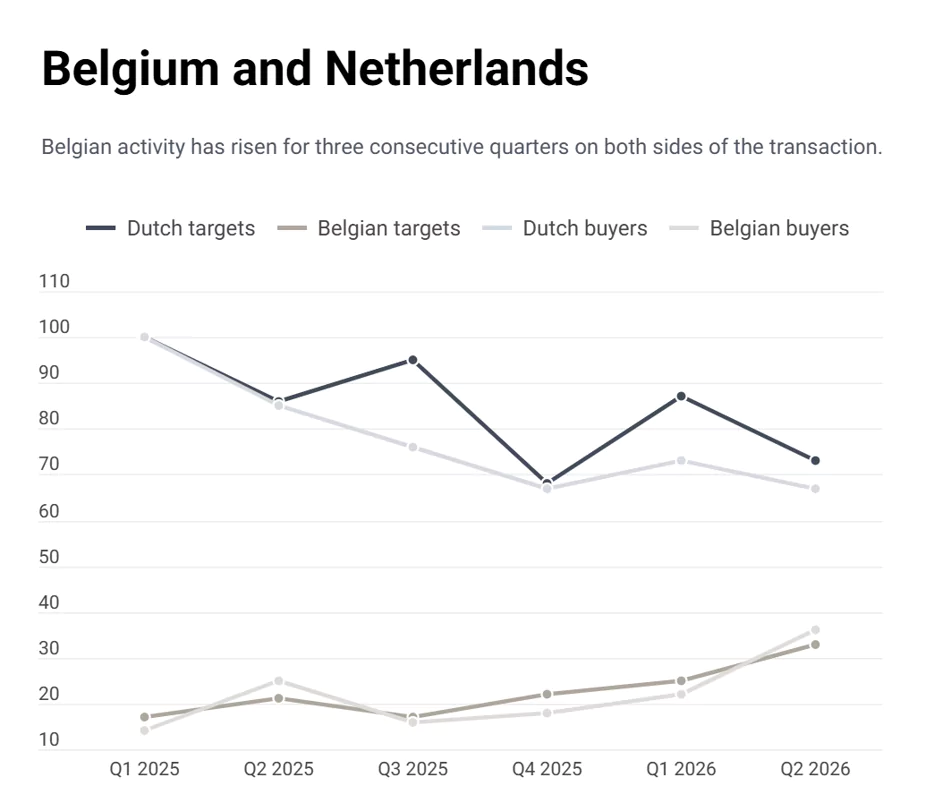
The vertical axis shows the number of transactions.
“Belgium has been the quieter half of the Benelux story for several years, and that is changing,” notes De Visser. “Belgian mid-market IT services and software businesses have reached the scale where they are credible consolidators rather than only consolidation targets, and a number of Belgian platforms used the quarter to move decisively. Three consecutive quarters of movement on both the buy side and the sell side is no longer something we would attribute to noise.”
Benelux buyers go on the offensive abroad
A second geographic shift concerns the direction of cross-border flow. Cross-border transactions accounted for 77 of the 141 deals, or 55% of volume, broadly consistent with recent quarters.
The composition of that flow, however, inverted. Inbound transactions, where a foreign buyer acquired a Benelux target, numbered 35, down from 40 in Q1. Outbound transactions, where a Benelux acquirer bought abroad, rose to 32 from 23, an increase of 39% quarter-on-quarter. The region moved from being a clear net importer of acquisition capital to something close to balance.
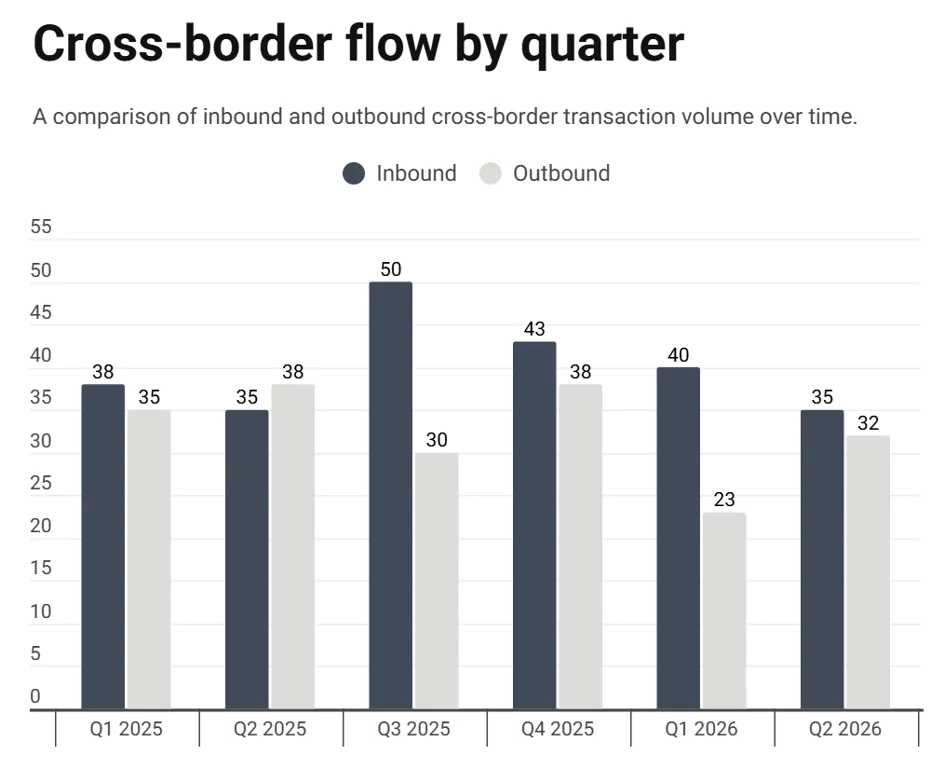
The vertical axis shows the number of transactions.
The outbound destinations are instructive: eight US targets, four in the United Kingdom, and three each in Italy, France and Spain. US acquirers of Benelux assets, meanwhile, fell to seven from 12 in Q1. The euro weakened against the dollar over the quarter, from a 2026 high near 1.20 in January to approximately 1.14 by mid-June, which cuts directly against the dynamic described in our Q1 commentary. A stronger dollar makes European assets cheaper for American buyers, yet US inbound activity fell rather than rose. The constraint on transatlantic dealmaking is currently strategic selectivity, not currency.
German buyers matched US buyers at six inbound transactions, with UK acquirers close behind at five.
Software holds its share as the valuation gap widens
B2B software remained the dominant target sector at 60 transactions, or 43% of total volume, essentially unchanged from 59 in Q1. IT services followed at 34 transactions, down from 39.
Beneath these two categories, the quarter produced a noticeably broader sector mix than Q1. Cloud services contributed seven deals, technology eight, fintech six and cybersecurity five, against effectively no recorded activity in either fintech or cybersecurity in the first quarter. Telecoms and internet services, which together accounted for 14 transactions in Q1, contributed two.
The re-emergence of cybersecurity was anticipated in our Q1 commentary and has now materialised, with transactions including Cegeka’s acquisition of 3Point, Approach Cyber’s acquisition of AXS Guard, ESET’s acquisition of Cyber Defense Group, and Aikido Security’s acquisition of US-based Root.io. Notably, four of the five were Belgian-led, reinforcing the geographic shift described above. Fintech followed a similar pattern, with six transactions including Main Capital’s buy-out of Agenium, TrueLayer’s acquisition of In3, and Belfius Insurance’s acquisition of Insurlytech.
What the deal count does not capture is the widening dispersion in pricing. High-quality assets continue to command premium valuations, with competitive processes and limited discounting where the underlying business is performing. Assets that are struggling, by contrast, are being punished more severely than they would have been eighteen months ago. The gap between outperformers and underperformers has widened materially, and it is now the defining feature of the regional valuation environment. A market-average multiple has become an increasingly meaningless reference point.
“The gap between a good software asset and an average one is no longer a matter of a turn or two of revenue,” says De Visser. “It is a different market entirely. Retention still matters, but buyers interrogate it differently now. The question is no longer whether net retention is above 100%, it is whether that number survives contact with AI agents three years out. Being able to answer that has become a prerequisite for entering a competitive process rather than a value driver within one”
Founders sell, sponsors hold, and fresh capital lands
The quarter’s seller data illustrates where liquidity is and is not flowing. Private equity sellers accounted for just 12 transactions against 21 in Q2 2025, a decline of 43%. Individual founders and shareholders remained overwhelmingly the dominant seller cohort at 113 transactions, or 80% of volume, with corporate sellers contributing 16.
Against this backdrop, Dutch fundraising was the quarter’s counterpoint. Three substantial Dutch funds closed in Q2: Main Capital IX at €4.0 billion, Waterland Private Equity Fund X at €4.0 billion, and Main Foundation III at €1.25 billion. For a market whose exit channels were simultaneously narrowing, the scale of new commitment to the region’s established software investors is a meaningful signal.
That capital is being deployed immediately, and internationally. Main Capital was the most active acquirer in the dataset in Q2 with nine transactions, comprising three platform buy-outs, including Ferranti Computer Systems in Belgium and CarCollect in the Netherlands, alongside six add-ons executed through existing portfolio companies across Denmark, Germany, Norway and the Netherlands. Strikwerda Investments followed with five transactions. The MSP and IT services buy-and-build platforms identified in our Q1 commentary continued to execute, with Your.Cloud and Your.World collectively completing four transactions, and Odin, Smizer, Total Specific Solutions and Vortex Capital each completing two.
Outlook: a deferral, not a closure
Heading into H2 2026, the constraint on Benelux technology M&A has not changed so much as changed shape. The valuation question that dominated Q1 is now expressing itself through the exit channel: where buyers and sellers cannot agree on price, transactions are not being repriced, they are being postponed.
The regional evidence points consistently in one direction. Secondary buy-outs have effectively stopped. Private equity sellers are down 43% year-on-year. New platform formation, as measured by capital raises and buy-outs, is subdued relative to the volume of add-on activity being executed through existing portfolios. Sponsors are not short of capital, as the quarter’s fundraising demonstrates. They are short of acceptable ways to realise the assets they already hold.
The important qualification is that this looks like deferral rather than closure. Processes did not fail in Q2 so much as wait, and the resulting backlog is now visible in the forward pipeline. CFI’s mandate activity points to a substantial volume of private equity and venture capital exits coming to market in the second half, with Belgium a disproportionate contributor. The exit channel is not structurally broken; it is congested, and the congestion has been building for two quarters.
That has a practical consequence for sellers. A backlog releasing into a market where buyers have raised their bar means more assets competing for the attention of a more selective buyer group. Preparation quality, and the ability to answer the defensibility question before rather than during a process, will determine which assets clear at premium valuations and which discover that the widening dispersion described above applies to them.
For founder-owned businesses, which supplied 80% of the quarter’s sellers, the picture remains considerably more constructive. Strategic and sponsor-backed buyers are well capitalised, actively buying, and competing for a narrower set of assets than at any point in the past two years.
“We are advising clients to be honest about which of these two markets they are in,” concludes De Visser. “If you own an asset with genuine AI differentiation and embedded workflows, this is a good moment to transact, because the competitive set is thin and buyers with balance sheets are actively looking. If you own an asset that needs another eighteen months of product work to answer the defensibility question, forcing a process into this market is the expensive choice. The businesses that will disappoint their investors over the next two years are not the ones that waited. They are the ones that went to market before they had an answer.”